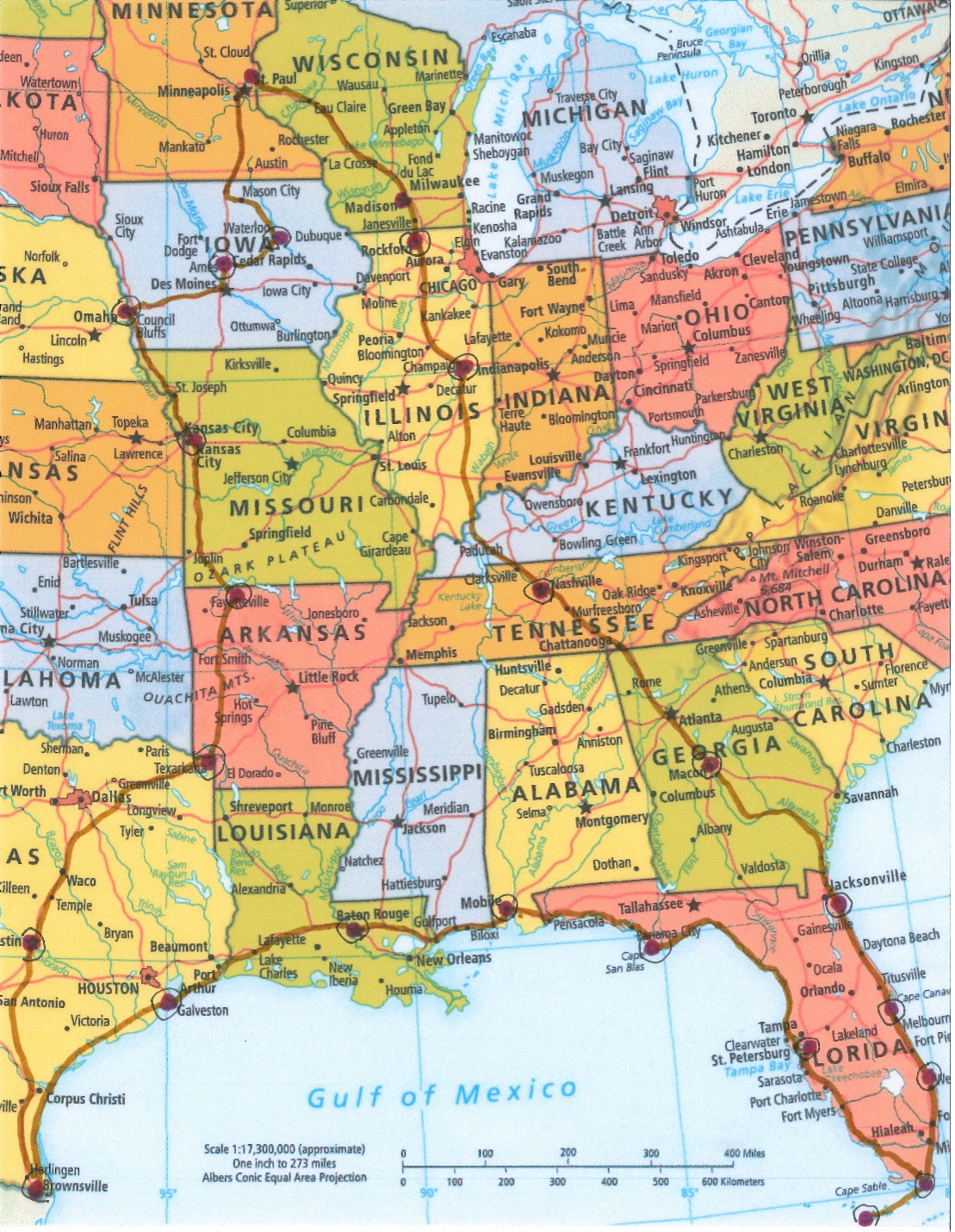
The morning I leave on this roadtrip to escape the cold, the temperature is 18 degrees below zero, I follow on the heels of Winter Storm ‘Fern’ and worry not about snow but rather power outages in Texas.
The trip is initiated by an invitation to guest lecture in the healthcare design studio at Iowa State University, andI build the trip around that. I start off with a visit to my class mate Daryl Andersen where his wife Jan fixes the most delicious scallops. A stop in Des Moines for coffee with Lynn Bowman, widow of another classmate. Dinner at my aunt and uncle’s in Omaha.
Then on to Brownsville, Texas, where I’ll begin sketching lighthouses. Other stops include Eureka Springs, Arkansas, where I have the second best dinner—pork tenderloin at the Rogue’s Manor; and, of course the Truman and Johnson Libraries.
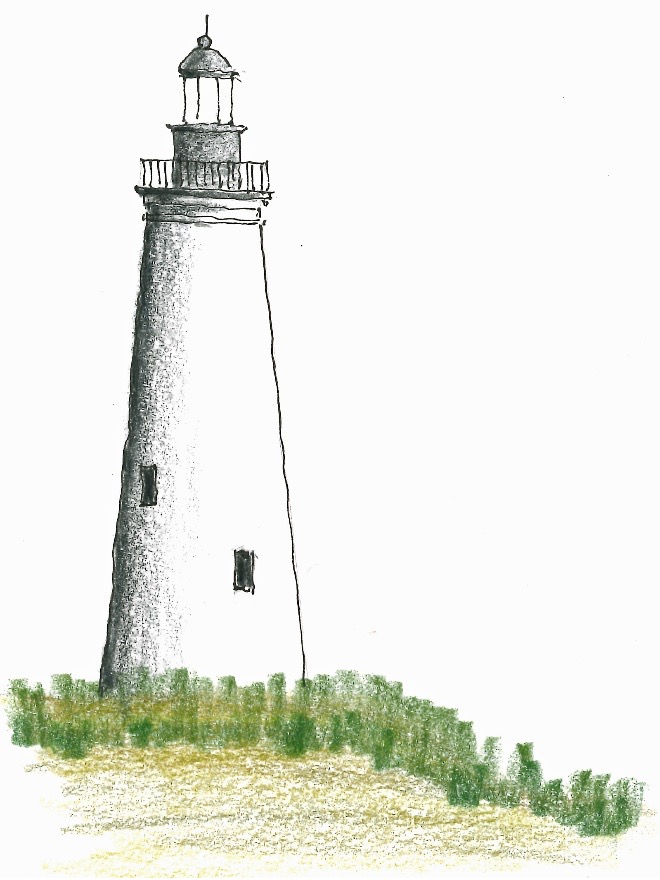
A little ways east of Brownsville is Port Isabel and right downtown is the Port Isabel Lighthouse. The museum isn’t open when I get there, but by the time I finish my sketch it is. I even get my US Lighthouse Society Passport stamped, the start of a trend.
#1 Point Isabel Lighthouse sits on a bluff on the north side of the Rio Grande River at the southeast corner ofTexas. The Rio Grande, which stretches 900 miles separating Mexico from Texas, would have been good for transport, but alas, too shallow. However, at its mouth, goods were unloaded from deeper crafts and loaded into shallow vessels for moving up river.
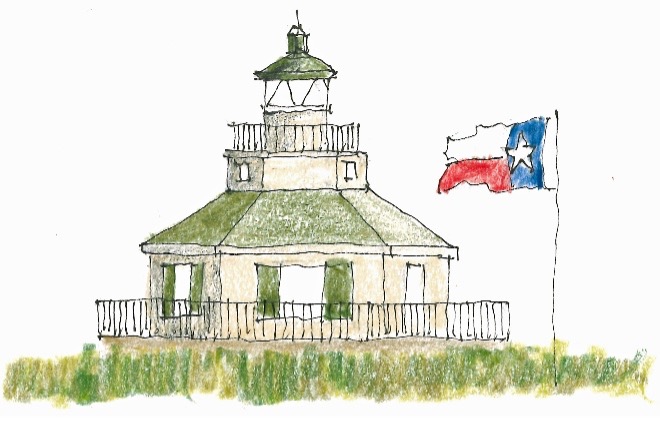
In the morning, as will be my modus operandi, I load up a couple of the great Holiday Inn Express cinnamon rolls and a couple travel mugs of their ground-and-brewed-while-you-wait coffee for the road and proceed to Port Lavaca, Texas. The Half Moon Lighthouse isn’t hard to find. The wind off the Gulf stretches out the Texas flag—it was left of the building but I use my artist’s license and move it to the right.
#2 In 1858the Halfmoon Reef Lighthouse was constructed at the southern tip of Halfmoon Reef on the eastern side of Matagorda Bay. It was a hexagon lighthouse mounted on screw piles sunk 9’ into the bay. In 1919 a hurricane struck the lighthouse and the keeper, Henry Welch, mysteriously disappeared. His body was recovered two days later washed up on shore 12 miles away. It’s believed he fell from the lighthouse which was two miles away from land. The lighthouse has been removed from the reef, restored, and relocated to Port Lavaca, Texas.
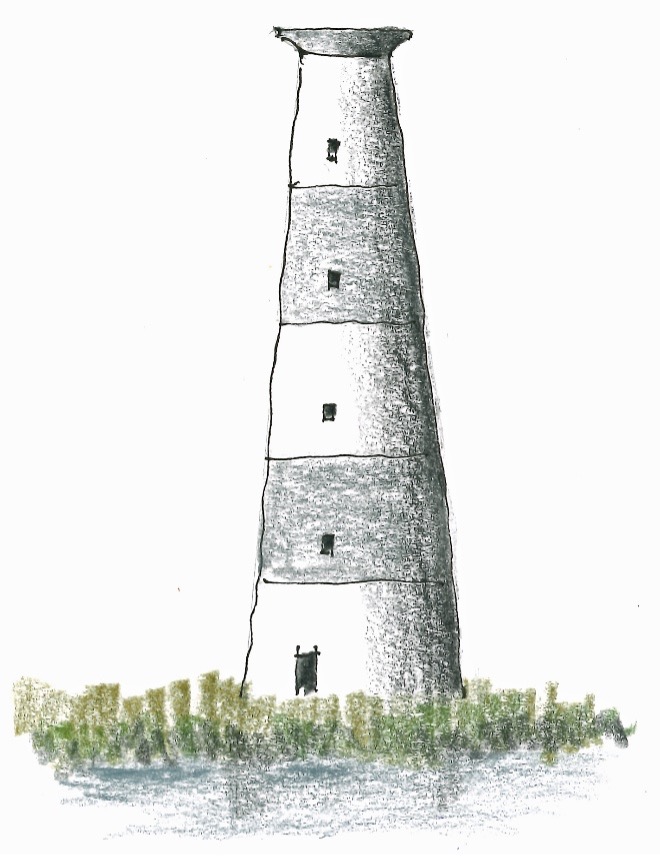
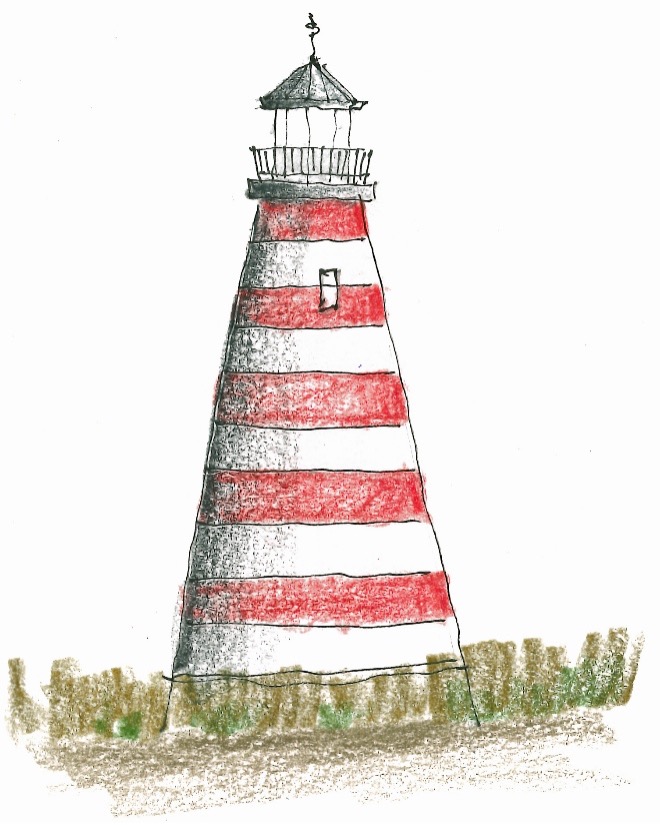
I spend the night in Galveston, Texas, which is on an outer bank not far from Houston. In the morning a ferry takes me across the inlet to the Bolivar Lighthouse. I pull the car over, get out my folding chair, and make a sketch. Temperature is in the 50s but I don’t need mittens. The lantern room is missing but still a handsome structure with its daymark of black and white stripes.
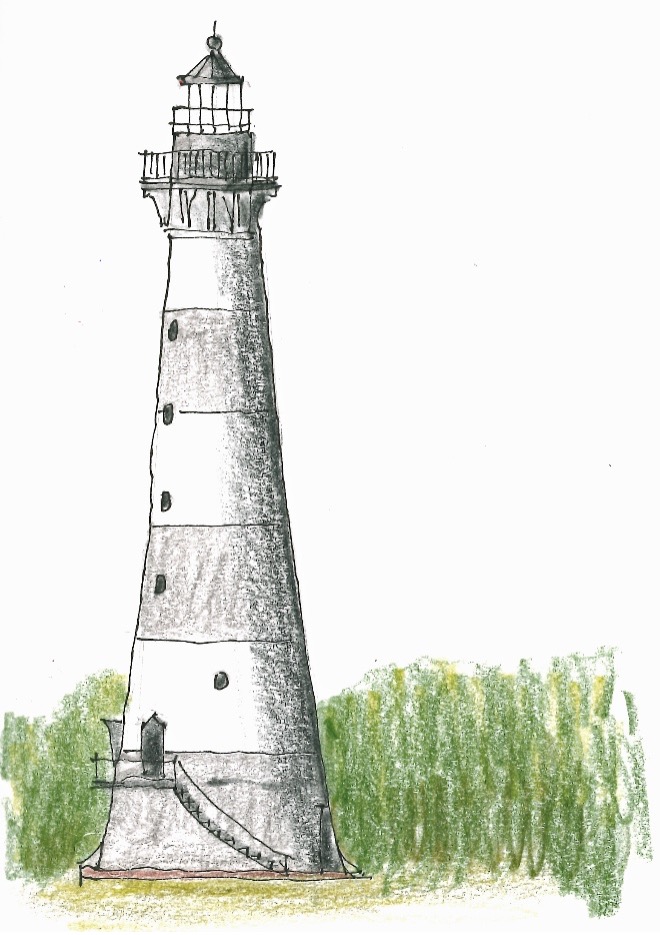
#3 Bolivar Point Lighthouse is located at the western end of Bolivar Peninsula marking the entrance to Galveston Bay and Houston beyond. The 65’ cast iron tower was erected in the mid-1800s, but during negotiations for the land, a lightship had to be deployed there. Throughout the Civil War the lighthouse was not only darkened; it was completely dismantled. It’s likely the cast iron was melted down for military purposes. A 34’ wood structure was established at the site in 1865, but replaced with another cast iron tower in 1872. To survive the 1900 hurricane, 120 people sought refuge in the tower sitting in pairs along the spiral stair. The hurricane claimed the lives of 6,000 residents in the Galveston area. The lighthouse saved 60 from the 1915 hurricane. Bolivar Point Lighthouse Foundation currently maintains the lighthouse.
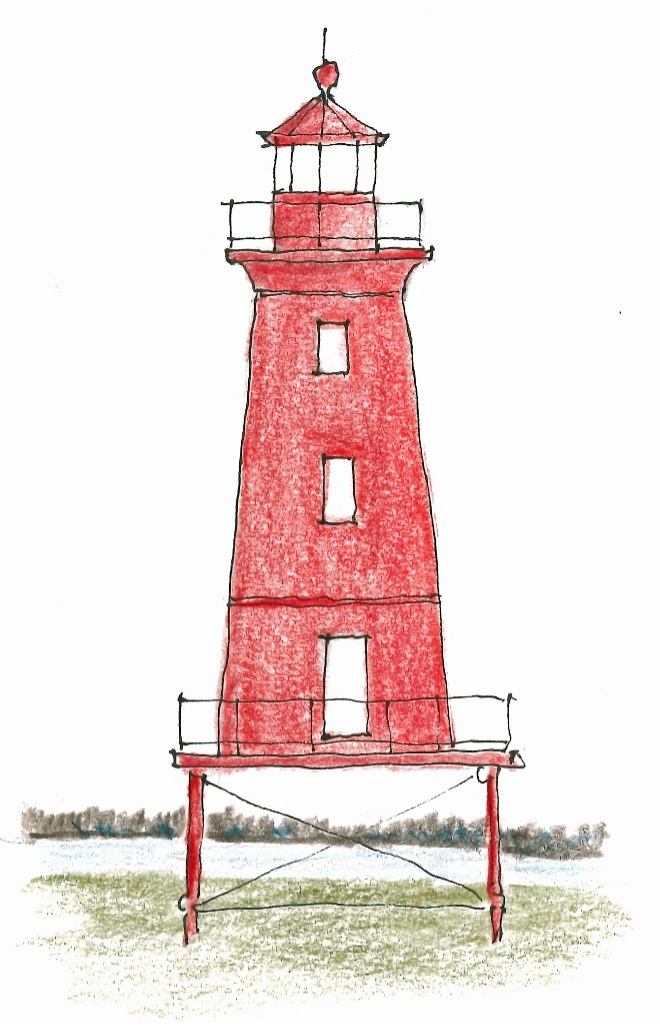
Unable to get to Sabine Lighthouse, I drive on to Berwick, Louisiana, and sketch the Southwest Reef Lighthouse. Berwick sits across the Atchafalaya River outflow where it meets the Bayou Shaffer. In 2003 I’d gone down the Mississippi from Hastings, Minnesota, to New Orleans with my friend Al Rawlings in his 26’ cruiser. We’d sailed down the Atchafalaya River between Berwick and Morgan City. This brings back a flock of memories. This section of the trip was the most challenging, nothing had prepared us for it.
#4 In 1827 the first lighthouse was placed on the east side of Atchafalaya Bay, southwest of New Orleans, to mark a shoal. It proved inadequate and a lightship was anchored to mark the shoal. The cast iron Southwest Reef Lighthouse was mounted on screw piles in 1859. But in 1916 it was deactivated and stood rusting away for 70 years until the Atchafalaya Delta Tourist Commission, the town of Berwick and Save Our Coast joined forces to bring it ashore in 1987. It stands today on the western bank of the Atchafalaya River in Everett Berry Lighthouse Park in Berwick, Louisiana.
In Baton Rouge, Louisiana, I have supper at a neighborhood place. Pork chop and red beans and rice. At one table sits a Caucasian family and at another an African American family. I think, why can’t we all get along like this?
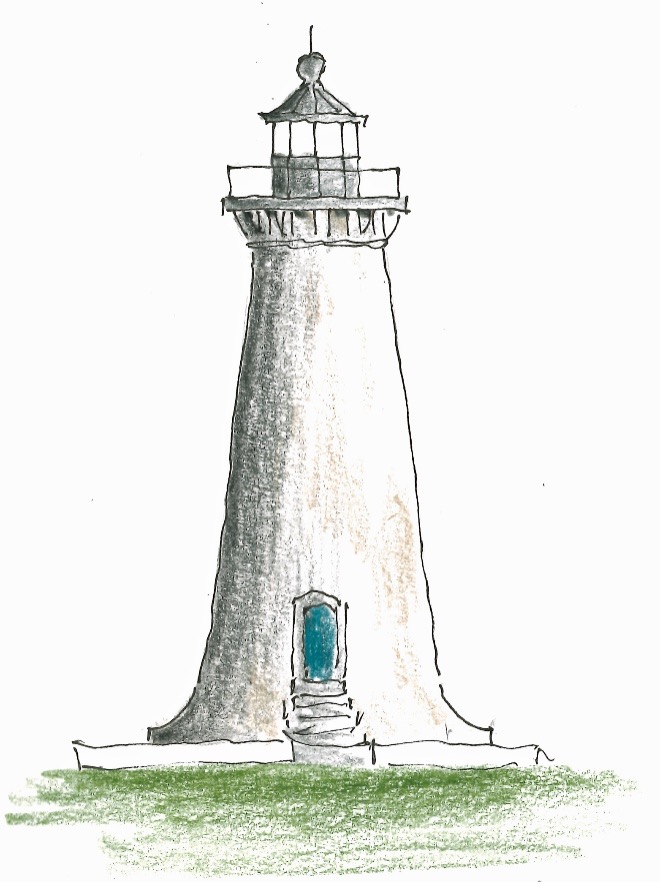
Next morning it’s an easy drive to Pascagoula, Mississippi, where I sketch the Round Island Lighthouse. It sits right beside US-90 just like the Biloxi Lighthouse. In fact, they’re both white painted Classic Style lighthouses, the difference being Biloxi is cast iron and not brick.
#5 Round Island was named by French explorer Pierre d’Iberville in 1699. The first Round Island Lighthouse was completed in 1834 marking the outflow of the Pascagoula River into the Gulf of Mexico. A replacement brick tower was built farther inland in 1859. When a hurricane struck the island in 1860, the keeper, his wife, and six children took refuge in the tower while their dwelling and all their possessions were washed away. In 1955, the General Services Administration declared it excess property. In 1986 the City of Pascagoula took over the lighthouse and the Round Island LighthousePreservation Society was formed. Hurricane Georges toppled the lighthouse in 1998. Restoration was underway when Katrina hit in 2005 delivering a deathblow, but by 2015 it had been rebuilt farther inland and relit where it stands today alongside US-90 in Pascagoula, Mississippi.
I get to Mobile, Alabama, in time to take the trolly ride around town. I’m on the ninth floor of the fancy pants Admiral Hotel. My Levi’s aren’t fancy enough to let me in their dining room so I opt for the lounge where the menu is the same. I celebrated eight states with halibut and a martini.
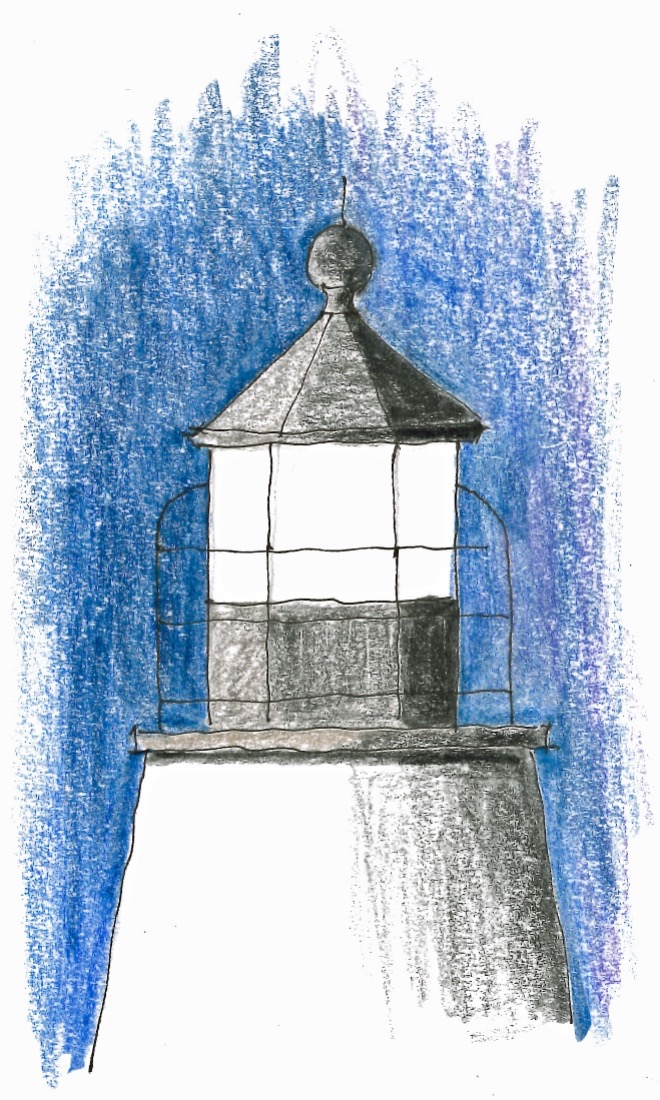
In the morning, I take a pass on the Mobile Point Lighthouse since I’d found out it’s just a short steel framed affair. Then onto the Forgotten Coast, St George Lighthouse, and the Gibson Inn, in Apalachicola, Florida. It’s my second visit to this charming part of the country. The sky so blue I can’t help but sketch the lantern room again.
#6 The first St George Lighthouse dates from 1833, constructed to mark the narrow entrance to the cotton port of Apalachicola Bay. When it succumbed to storm damage, it was taken down and the bricks used for a new lighthouse completed in 1848 onCape St George. A hurricane blew the tower apart in 1851, but by 1852 a third lighthouse had been erected farther inland again using materials salvaged from its predecessor. In 1949 the lens was replaced with an automated light which the Coast Guard serviced until the lighthouse was retired in 1994. The next year Hurricane Opal washed away the foundation and left the light leaning at a seven-degree angle, sealing its fate. But the community rallied to save their beacon. The St George Lighthouse Association was formed. Volunteers got busy salvaging brick, granite door frame and window lintels, reforging the lantern room, and acquiring a copy of the old plans from the National Archives. They're built the lighthouse yet a fourth time to a height of 70-feet on the mainland of St George Island where it stands today along with a replica of the keeper’s quarters now housing a museum.
Sitting at the bar I get to know the couple next tome from Akron, Ohio. Four kids, 11 grandkids, very alarmed about Trump. The guy used to run a Chevy dealership and has a ’78 Chevy pickup same year as Ol’ Blue, my F-150 Ranger. He’d spiffed it up and said he’d never get out what he’s got in it. His wife said, “What!?” I excused myself and stepped into the adjacentFranklin Cafe for shrimp and grits. Why get involved in a domestic.
In the Franklin Café for breakfast, I splurge on coffee, a biscuit, grits, over medium eggs, crispy bacon, and orange juice—no need for lunch today. On my way to Dick and Brenda Carlson’s in Sarasota, Florida—another classmate—I try to find the Tierra Verde Lighthouse amidst terrific traffic. I can’t find it, but I sketch what I find. I call it the Parking Lot Lighthouse.
#7 Parking Lot Lighthouse does sit at the corner of a parking lot. Its origin and purpose are unknown, but it’s clearly not a real lighthouse but rather a monument.
After a swell time at Brenda and Dick’s I move on to Boca Grande Front Range Lighthouse and Boca Grande Entrance Rear Range Lighthouse.
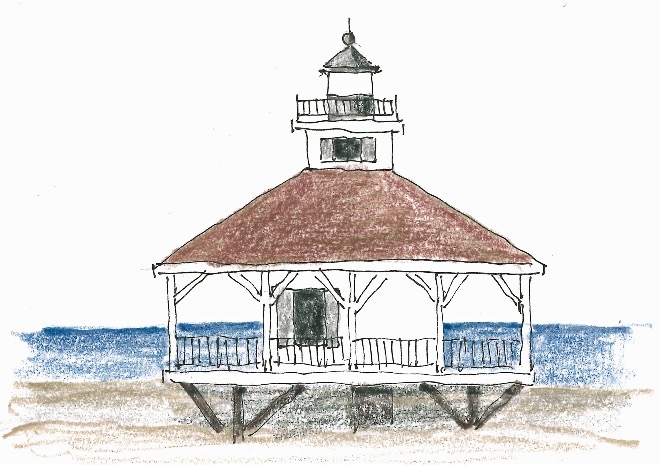
#8 Perched on iron pilings at the southern end of Gasparilla Island is the restored 1890 Cottage Style Port Boca Grande Front Range Lighthouse (aka Gasparilla Island Lighthouse)and museum. In the early 1880s, phosphate was floated down the Peace River and loaded on ships at Port Boca Grande. Like many lighthouses, Boca Grand is haunted but not by keeper Fine who took his life with a shotgun, but by his daughter who died at the lighthouse and by Josefa, a Spanish princess allegedly decapitated by Jose Gaspar a pirate whose name was the prompt for the island’s name. The lighthouse and surrounding 13 acres became Gasparilla Island State Park in 1988.
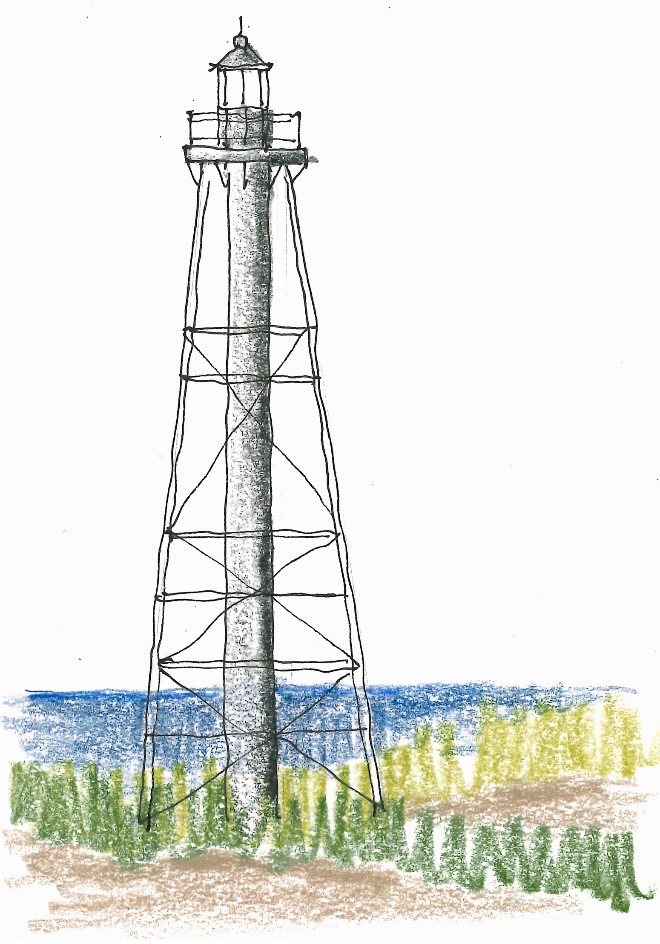
#9 The 105’ SkeletonFrame Style Boca Grande Entrance Rear Range Lighthouse had a previous life in Delaware where it had been assembled in 1881. In 1927 it was disassembled and relocated to Gasparilla Island. The lighthouse was deactivated in 2017, but the Barrier Island ParkSociety has restored it. No stories of ghosts here since no one actually lived in or nearby the lighthouse. Too bad.
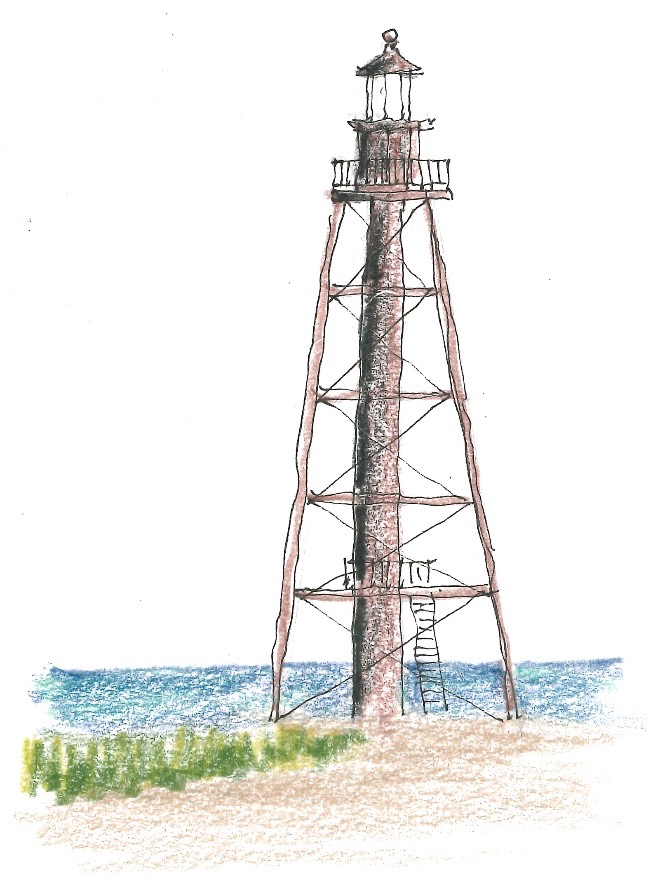
Then a hop, skip and a jump to Sanibel Island Lighthouse. In 2022 I’d planned to sketch Sanibel, but Hurricane Ian had devastated the place: destroyed all the buildings and left the lighthouse standing on just three legs. When I get there, it’s stands on all four legs.
#10 The 1884 Skeleton Frame Style Sanibel Lighthouse or Point Ybel Light was one of the first north of Key West. It announced the way to Punta Rassa, a major port for cattle being shipped to Cuba. Even though he was illiterate—making record keeping difficult—Henry Shanahan became head keeper in 1892. A few years later his wife died leaving him to raise their seven children. A widow Irene Rutland was also living on the island and had five children. Before too long Irene and Henry were married, had a son, and together raised 13 children. The lighthouse was transferred to the City of Sanibel in 2004.
After Sanibel a long drive on US-41 across the Everglades eventually arriving after dark at the Dove Creek Resort in Key Largo. There was a sports bar of sorts next door. I order an old fashioned. Another wait person comes by, and I order clam chowder and key lime pie since they’re out of fish and chips. The pie comes immediately, then the chowder, and after I was through eating the old fashioned arrives. Not complaining, it was just quaint. I’m so late I’m lucky to get anything.
At breakfast, I meet a couple from Woodbury, Minnesota, a suburb of St Paul. She wants to take my sketching class at Marine Mills. Small world.
Later, I search in vain for Key Largo Lighthouse. I think I locate it but can’t get close enough for a view. So, on through the keys to Key West Lighthouse. My son Mark—whose side hustle is travel planning—booked me into the Lighthouse Hotel, a nice but overpriced place right in the heart of town, adjacent to the lighthouse grounds, across the street from Hemingway’s digs, and near Truman’s little White House. At a restaurant called 915, I order lobster risotto, but they don’t have key lime pie! I’d had a key lime ice cream cone for lunch, and walking back to the hotel I buy a frozen chocolate covered key lime sherbet on a stick. How decadent.
#11 The first Key West lighthouse was a 65’ tower completed in 1826. The first keeper was Michael Mabrity and his wife Barbara was assistant keeper, a rather uncommon arrangement. When Michael died of Yellow Fever in 1832, Barbara took over as head keeper. By herself she raised their six children and served the light for 38 years. The hurricane of 1846 toppled the lighthouse, but Barbara survived. By 1849 a new 50’ tower was in place and by 1895 it had been extended to 86’. The battleship Maine stopped by on its way to Cuba in 1898. The Key West Art and Historical Society has restored the lighthouse and established a museum on the grounds.
After coffee and Danish by the pool, I backtrack all the way back to Key Largo and on out to Cape Florida Lighthouse on Key Biscayne. President Richard Nixon had a winter White House on Key Biscayne right next to Bebe Rebozo’s place. Rebozo, owner of the Key Biscayne Bank, was indicted for money-laundering a donation to the Nixon election campaign. Nixon resigned under a dark cloud after Watergate.
#12 The 1700s found the beaches of Key Biscayne the happy hunting grounds of marauding pirates, wreckers, and bands of Indians. The pirate Black Caesar terrorized the coast—he was caught and hanged in 1718. Designed by George Meade, Cape Florida Lighthouse was first lit in 1825, but difficulties followed. During the Second Seminole War in 1836, the lighthouse was destroyed and not rebuilt for ten years. The lighthouse rose to95’ in 1855. The light was doused during the Civil War, placed back in service in 1866, extinguished in 1878 because it was replaced by the offshore Fowey Rocks Lighthouse. In 1966 the state of Florida purchased the lighthouse and established a state park. It was restored and relit in 1978, 100 years after extinguishment. But in 1992 along came Hurricane Andrew…once again the light went dark, but restored and relit in 1996.
There were no clouds in the sky as I drive on to Jupiter, Florida, and the Jupiter Lighthouse which is shining as I arrive after dark. Dinner at the Food Shack where I dig into the chef’s dinner plate of salmon, shrimp, mashed potatoes and veggies. A loud and obnoxious New Yorker sits behind me. He contributes to the entertainment and also makes up for the ambiance shortage.
#13 Designed byGeorge Meade and William Raynolds, Jupiter Inlet Lighthouse was completed in 1860. The 108’ lighthouse sits on a natural parabolic sand dune near the confluence of the Loxahatchee and IndianRivers. Burt Reynolds, of Hollywood fame, outshone the lighthouse for a time—he had a sprawling ranch in Jupiter before his bankruptcy. The Loxahatchee Historical Society provides public tours of the lighthouse. A gift shop and museum are housed in what were the married men’s quarters for the Navy duringWorld War II.
Next morning I sketch the lighthouse and drive north on FL-A1A to Cocoa Beach. I stop by the building where my dad and I had owned a condo. I sit on the beach and enjoy the surf, and check out the tennis court where dad usually beat me. More memories of getting together here—the kids, my dad and grandmother…
Dinner at the Sunset on the Waterfront Bar and Grill where I do the sunset. Shrimp trio (three shrimp prepared three different ways for a total of nine), house salad, key lime pie, Prosecco. It had been a beautiful day and the memories moved it along.
No cinnamon rolls at the Beachside Hotel & Suites so I opt for an Egg McMuffin, OJ and coffee at McDonalds right across FL-A1A. Just a short drive up to Cape Canaveral where I’d signed up for a tour so I could get to the Cape Canaveral Lighthouse and museum.
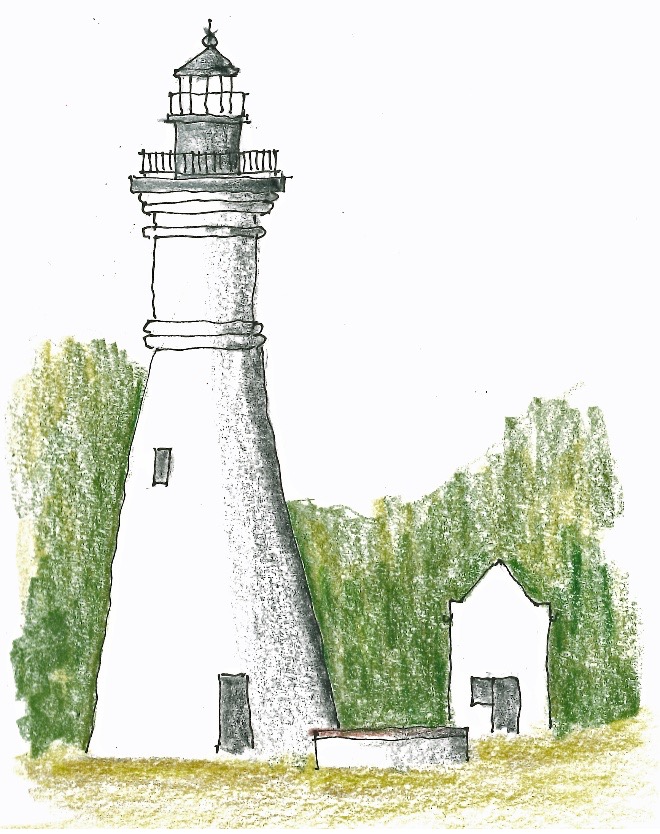
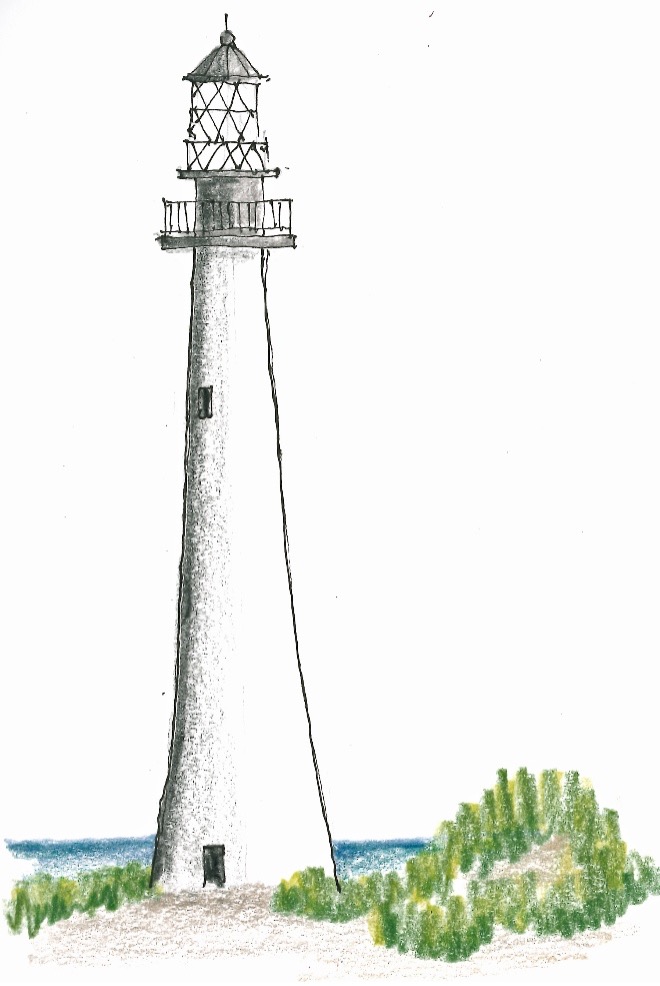
#14 The first Cape Canaveral (cane) Lighthouse was a 65’ structure put up in 1848 to warn mariners of shoals that extended for 12 miles off the cape. It was replaced in 1868 by a 145’ Classic Style cast iron tower. Because of eroding shoreline, the tower was disassembled and relocated further inland in 1894. President Truman signed legislation in 1949 establishing the Joint Long-Range Proving Ground at Cape Canaveral, and rocket launches soon began. Only the keepers and their families were allowed to live on the cape. The Air Force owns the lighthouse, but the Cape Canaveral Lighthouse Foundation and Brevard County have also been involved in its restoration and replication of the keepers’ quarters.
On the road again to Ponce de Leon Lighthouse. Steven Crane, noted author of The Red Badge of Courage, was shipwrecked off the coast here while en route to Cuba. He set out with the ship’s captain and two sailors in a small boat. Fortunately, the Mosquito Inlet Lighthouse showed them the way, and after 27 hours they got to shore. Crane wrote up the story in The Open Boat.
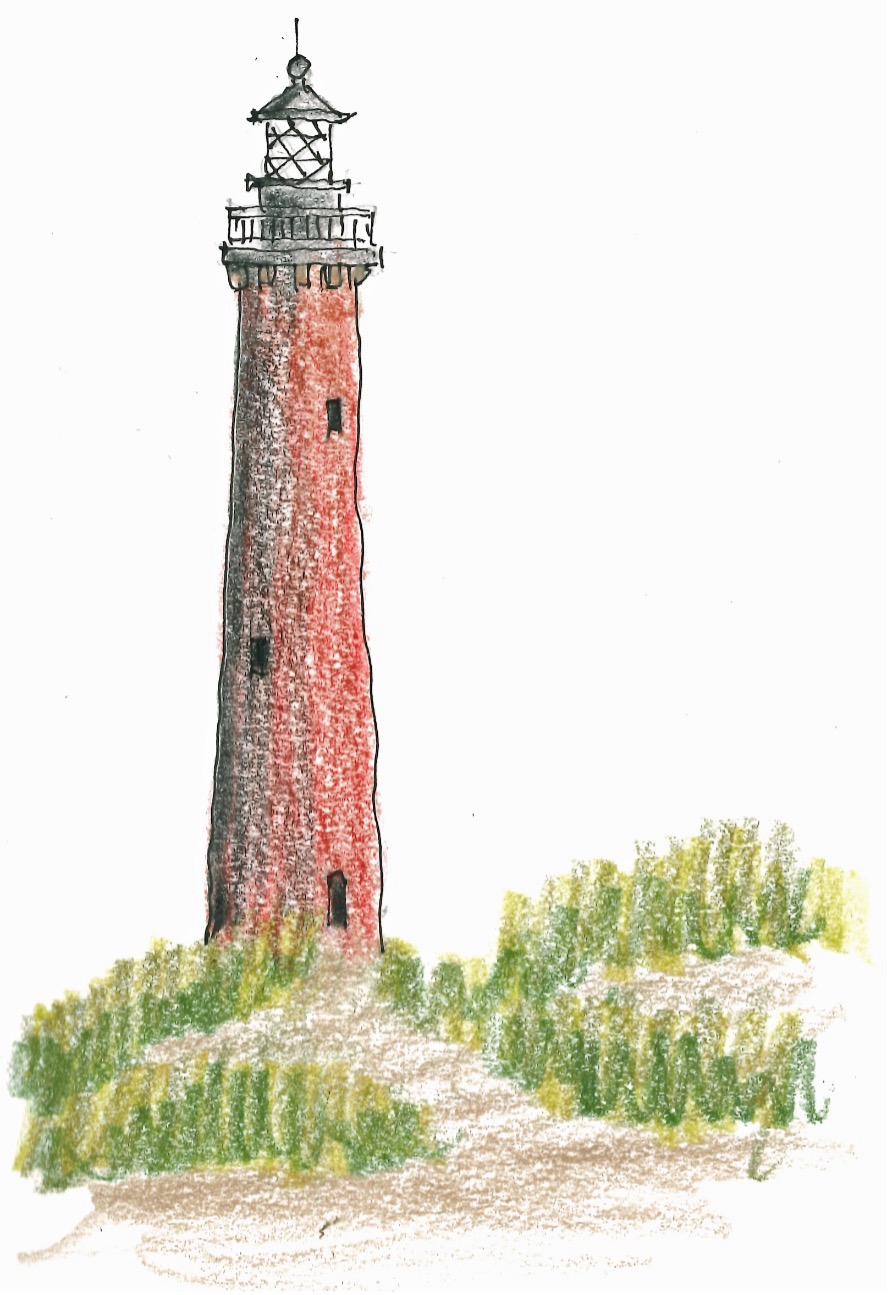
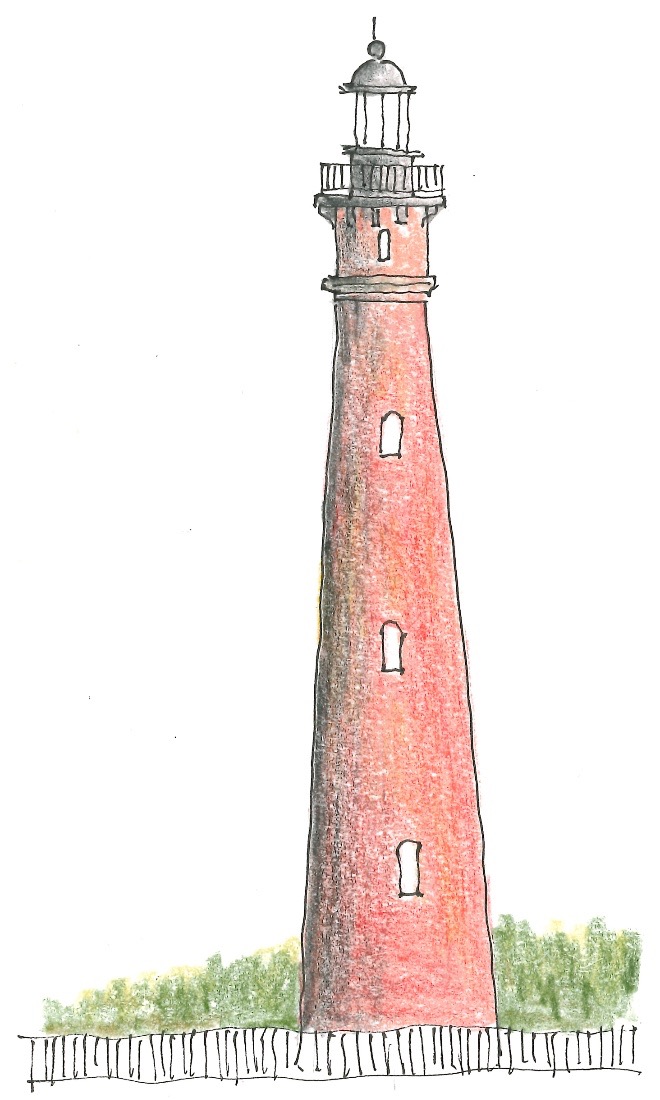
#15 Paul Pelz and Civil War general Orville Babcock designed the 175’ Ponce de Leon Inlet Lighthouse which was erected in 1887 to mark the north side of the confluence of the Halifax River and the Indian River as they give their waters to the Atlantic. Cotton, rice, and oranges were shipped from this inlet, one of the most dangerous on the coast. Babcock was being rowed ashore to commence construction of the Mosquito Inlet Lighthouse on the south side of the inlet when his small boat capsized in rough water—he and three others drowned.
That afternoon I arrive in St Augustine, Florida. This time I have a reservation Mark’s made for me at the Bayfront Inn, and I don’t have to hunt up a place to stay in this place packed with tourists. I swung by the lighthouse which I’d sketched and climbed in 2022. I’m lucky enough to find a parking place at Harry’s Seafood Bar and Grill where I enjoy scallops—not as good as Jan’s.
Then a 300-mile drive to Macon, Georgia, where all was peaceful, and I didn’t get mugged like in Savannah in 2022. I’d like to eat at Natalia’s, a quiet place with tablecloths, but it was full of pre-Valentine’sDay celebrants on Friday the 13th of February. So, a sports bar where I can see 14 TV screens without turning my head to see even more. Noise level 115 decibels, 200 kinds of beer, but hey, beats the Golden Arches.
After Macon I drive on up to Nashville, Tennessee, where I’d booked a show at the Grand Ole Oprey. I’m not a particular fan, but since I was in town...
Next day through Paduka, Kentucky, and on toChampaign-Urbana, Illinois, where I’d almost gone to college. The flattest land imaginable. On to Rockford, Illinois, where I’d come of age, and a four-hour lunch with high school friend Ron Toti.
Next day home and 65 degrees warmer than when I left. Snow melted on south facing slopes.






Comments